
Why does my crawl space smell musty?
A musty smell under the house almost always means moisture. Damp soil, damp air and old, wet insulation give off that earthy, stale odor.
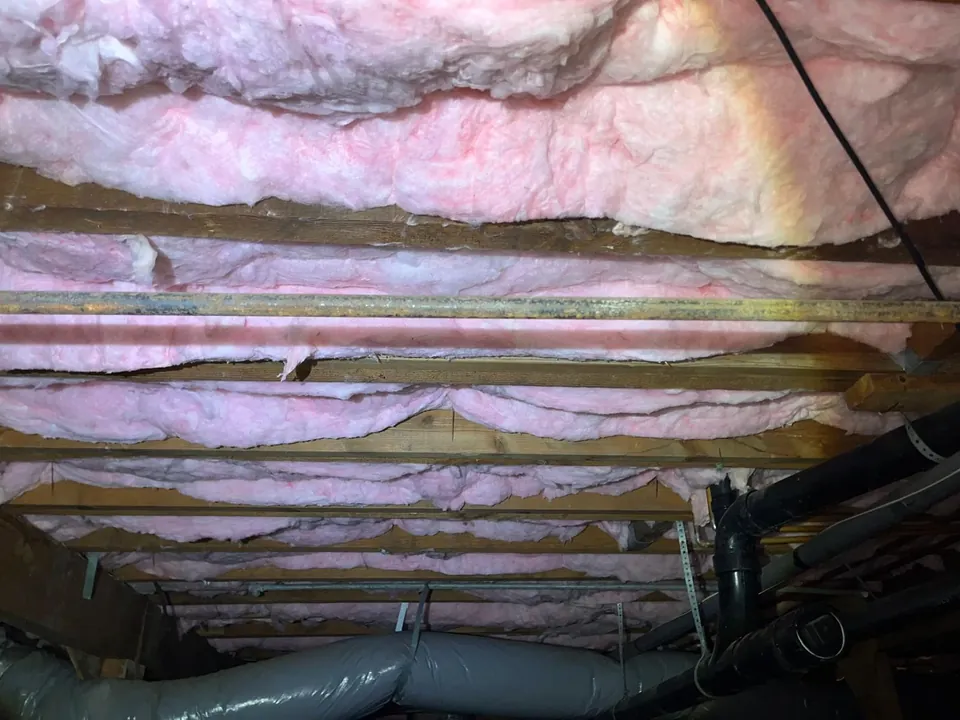
Many older Bay Area homes sit on raised foundations with a dirt crawl space underneath. The bare soil holds moisture, especially after winter rains, and homes in cooler, foggier spots near the bay or the coast tend to stay damper under the floor. Fallen batts and old, torn plastic sheeting soak up that moisture and hold on to the smell.
Why does it smell like urine or ammonia?
A sharp, ammonia-like smell usually means animals have been living under the house. Rodent urine soaks into the soil and insulation, and the smell builds up over time.
Rats and mice are the most common cause. Skunks and opossums also move into crawl spaces through a broken vent screen, and both leave a strong odor behind. If you also hear noises, read what that noise at night might be.
What if it smells like something died?
A strong, sweet, rotten smell that came on suddenly is usually a dead animal, often a rodent. It won’t go away for good until the animal is found and removed and the area is cleaned.
This often happens after someone puts out poison bait. The rodent eats it, then dies somewhere hidden under the floor or inside a wall. It is one of the reasons we don’t use poison. Warm weather makes the smell stronger.
How do I know the smell is coming from the crawl space?
If the smell is strongest close to the floor, in rooms right above the crawl space, or right after the heating or AC turns on, the crawl space is the likely source.
A few more clues help. The smell often gets worse after rain or in warm weather. Closets and cabinets along outside walls may smell first. Outside, look at the foundation vents: a torn or pushed-in screen, droppings near the vent or dug-out soil beside the foundation all point to animals under the house. If you can open the crawl space hatch, a quick sniff from the opening usually settles it. Don’t crawl in without gloves and a plan.
Can a crawl space smell get into the house?
Yes. Air from under the house rises into the rooms above through gaps around pipes, wires and ducts, and through openings in the floor.
If your heating and cooling ducts run through the crawl space, a torn or crushed duct can pull crawl space air straight into the system and blow it out of the vents. That is why a smell that seems to come “from the vents” can start under the floor. Damaged ducts can be replaced with new flexible insulated ducts.
Is it safe to go into the crawl space to look?
Be careful. If there are droppings, nests or a dead animal, don’t stir them up or touch them with bare hands.
The CDC says to wear gloves, never sweep or vacuum rodent droppings or nests, and soak them with disinfectant before cleaning up. For a dead rodent, the CDC says to disinfect it, double-bag it and wash your hands well afterward. A crawl space with droppings spread across the soil and insulation is a bigger job. See crawl space cleaning.
How do you get rid of a crawl space smell?
Remove what is causing it, sanitize, and stop it from coming back. Air fresheners and fans only cover the smell for a while.
A complete fix usually looks like this:
- Clean out: debris, droppings, nests and fallen or soiled insulation come out.
- Sanitize: the crawl space is sanitized after the cleanout.
- Seal: foundation vents and gaps are closed with galvanized steel mesh, putty and concrete, so animals can’t get back in. See rodent proofing.
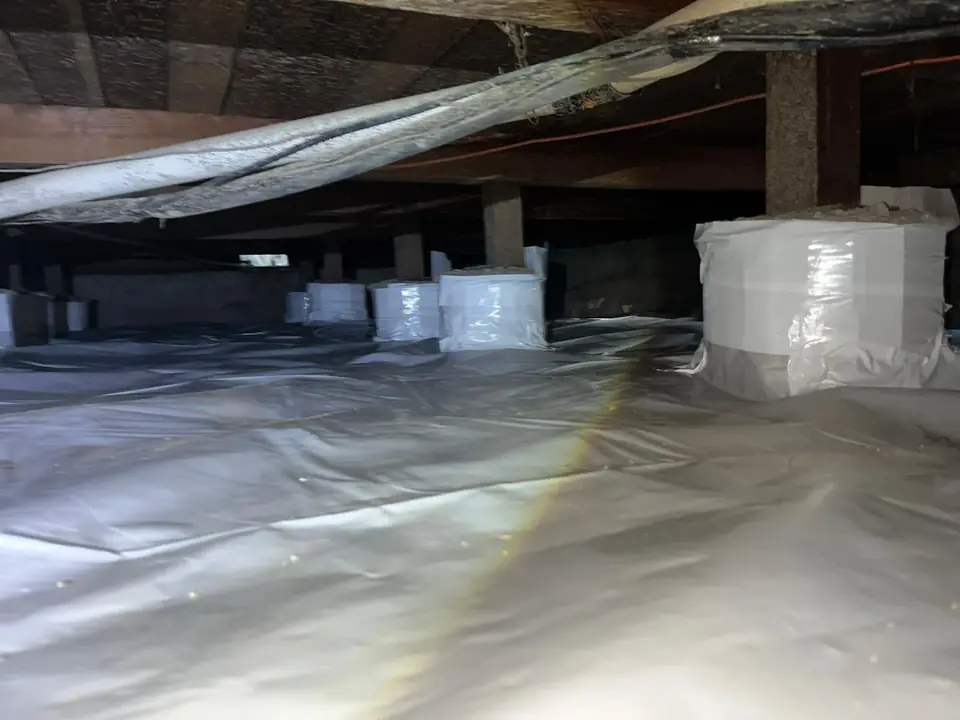
- Cover the soil: a vapor barrier goes over the ground.
- Insulate: new batts go between the floor joists where the old ones fell or were soiled.
Should I block the foundation vents to stop the smell?
No. Foundation vents let the crawl space breathe, and boarding them up can trap more moisture under the house. The fix is to keep animals out while the air still moves.
That means galvanized steel mesh screwed over each vent, with putty to close the edges and the gaps around pipes. Animals can’t get through, and air still can. See sealing outside openings for how we close vents, eaves and roof gaps.
Does a vapor barrier help with a musty smell?
It helps with the moisture side of it. A vapor barrier covers the bare soil, so less ground moisture gets into the crawl space air.
It is not a fix on its own if animals are the cause. The droppings and soiled insulation have to come out first, and the openings have to be sealed. Then the barrier goes down over clean ground. We install white, reinforced vapor barriers such as Viper CS, laid over the ground and wrapped around the piers. See vapor barrier.
What we see on real jobs
When homeowners in Palo Alto, Menlo Park or Fremont call about a smell under the house, we usually find a mix of these:
- Foundation vents with torn or missing screens.
- Droppings on the soil and in the insulation.
- Batts that have fallen from the floor joists and lie on the ground.
- Old plastic sheeting that is torn, dirty or missing.
- Ducts that are torn, crushed or disconnected.
We go under the house at the free inspection, photograph what we find, and send a written quote the same day. The crew takes before and after photos on the job day too, and sends them to you.